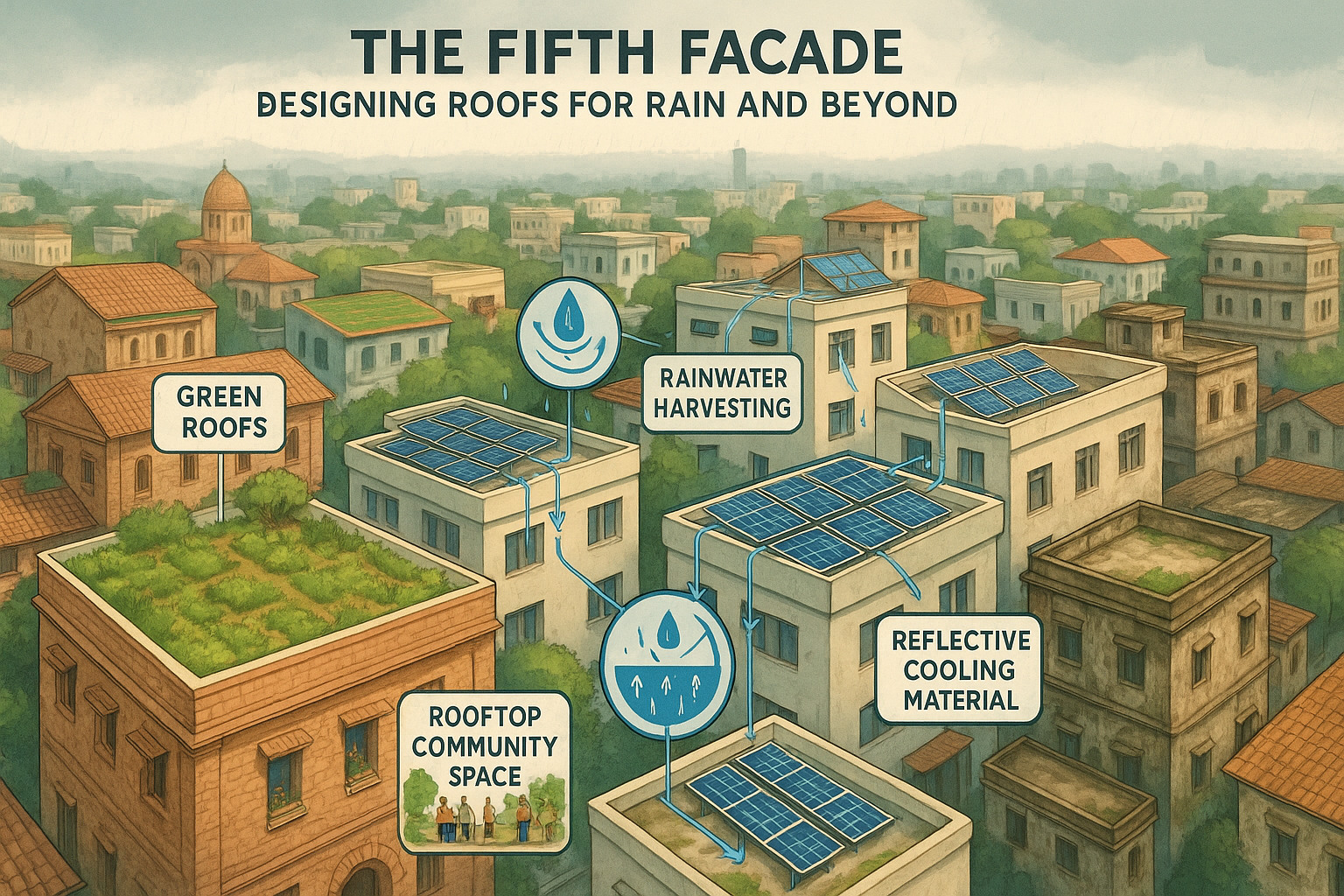
“𝙏𝙝𝙚 𝙁𝙞𝙛𝙩𝙝 𝙁𝙖𝙘𝙖𝙙𝙚: 𝘿𝙚𝙨𝙞𝙜𝙣𝙞𝙣𝙜 𝙍𝙤𝙤𝙛𝙨 𝙛𝙤𝙧 𝙍𝙖𝙞𝙣 𝙖𝙣𝙙 𝘽𝙚𝙮𝙤𝙣𝙙”
DESIGNO Architects, is a Leading Architectural firm in Navi Mumbai, led by Principal Architect Pradeep Dhore, with over 1500+ successful projects. We specialize in residential, commercial, and industrial architecture, blending interiors and exteriors seamlessly. Driven by innovation and user-centric design, we deliver timeless, functional spaces aligned with modern trends. Our commitment to quality, creativity, and value ensures every project exceeds expectations.
Introduction: Rethinking the Roof
Traditionally viewed as a protective cap to shelter us from the elements, the roof has been one of architecture's most overlooked features. Yet, in the context of climate change, water stress, rapid urbanization, and design innovation, the rooftop is emerging as a vital design element—a true "fifth facade." No longer just a passive layer, the roof can actively manage rainwater, generate energy, foster community engagement, and even nourish biodiversity.
This evolution is particularly significant in India, where monsoonal rains, high solar radiation, and urban heat islands present both challenges and opportunities. Architects are now reimagining the rooftop as a dynamic, multifunctional surface that contributes to sustainability, aesthetics, and urban livability.
Historical Wisdom: Traditional Roofs and Rain Management
Pitched and Sloped Roofs
In rain-rich regions like Kerala and the Konkan coast, traditional homes featured sloped Mangalore tile roofs. These not only shed heavy monsoon rains efficiently but also protected walls and courtyards through deep eaves. Bamboo or terracotta gutters often complemented the system to direct water into collection tanks.
Flat Roofs and Water Harvesting
In arid regions like Rajasthan, where rainfall is scarce, roofs were flat but subtly sloped to guide rainwater into underground storage systems like tankas and baolis. The integration of architectural form with water conservation is a testament to India's ancient hydrological wisdom.
Rooftops as Living Surfaces
In Tamil Nadu and Bengal, flat lime-surki roofs served not just functional purposes but were used for drying crops, celebrating festivals, or simply escaping the heat—making them early examples of multifunctional rooftops.
Modern Technologies: Engineering Roofs for Rain and Resilience
Today’s rooftops are enhanced with modern materials and systems that make them more efficient and versatile. These advancements allow roofs to handle rain, heat, and urban pressures with elegance and effectiveness.
Green Roofs 🌿
Green or vegetated roofs absorb rainwater, delay runoff, and provide natural insulation. A layered system comprising waterproofing membranes, root barriers, drainage mats, and growing media transforms bare rooftops into living landscapes.
Green Roofs: Integrating Nature into Urban Spaces
Prestige University, Indore Designed by Sanjay Puri Architects, this university features a fully walkable, angled green roof accessible to staff and students.
Cocoon Pre-Primary School, India This school boasts an undulating green roof that mimics natural hills, creating a seamless blend with the landscape.
ONGC Green Roof, Dehradun A challenging structure with varied curves and angles, this project showcases a stunning green roof design.
Cool Roofs
Cool roofs use high-reflectivity coatings or materials like white lime plaster and reflective tiles to bounce solar radiation and reduce roof temperature. This not only improves indoor comfort but also mitigates the urban heat island effect.
Telangana's Cool Roof Policy An initiative to implement cool roofs across the state to mitigate extreme heat effects. : The Telangana Cool Roof Policy encourages residents to adopt cool roofing solutions, particularly in low-income housing, as a climate-adaptation strategy.
Cool Roofs in Delhi's Informal Settlements Low-cost eco-roofs have been introduced to reduce indoor temperatures by up to 6°C.
Solar Roofs
Roofs are ideal platforms for solar photovoltaic systems, especially in tropical countries like India. Advanced drainage design ensures water doesn’t accumulate around the mounting structures.
Example: The Indira Paryavaran Bhavan in New Delhi uses its rooftop to host a 930 kW solar power system while integrating rainwater harvesting pits and recharge wells.
☀️ Solar Roofs: Harnessing Renewable Energy
Ornate InRoof – Integrated Solar Roof Solution India's first integrated waterproof solar roof, combining aesthetics with functionality.
Atum – Integrated Solar Roof A sleek and simpler integrated solar roofing system that increases energy generation by 20%.
Walkable and Public Roofs
Thanks to advanced waterproofing systems and surface treatments, rooftops can now be turned into leisure decks, cafes, parks, and performance spaces—even in areas with heavy rainfall.
Example: The Jawahar Kala Kendra in Jaipur includes walkable roofs and terraces that serve as cultural and experiential spaces, blending tradition and modernity.
Sloping Brick Library, Kopargaon A vaulted brick structure that rises into a mound-like extension, allowing people to walk over it.
💧 Rainwater Harvesting: Sustainable Water Management
Rainwater Harvesting by Jateen Lad Architect A model rainwater harvesting system based on age-old principles to capture monsoon rains.
Efficient Water Management in Indian Residential Projects Examples showcasing rainwater harvesting systems integrated into residential designs.
The Fifth Facade: The Roof as an Urban Asset
The rooftop is increasingly recognized as an urban interface—a fifth facade that contributes to a city’s visual, climatic, and social fabric.
Aesthetic Integration
Rooftops are now viewed from high-rises and drones, making them critical to the overall architectural expression. Designers are incorporating pergolas, water channels, roof gardens, and expressive forms to elevate roof aesthetics.
Climate Moderation
Green and cool roofs significantly reduce surface temperatures, improving thermal comfort inside buildings and reducing reliance on air-conditioning. Collectively, they help counteract the urban heat island effect.
Social Activation
By creating shaded, walkable, and engaging roof spaces, architects are turning roofs into community assets. In dense urban areas, the roof becomes a stage for daily life—be it yoga classes, community gardening, or evening gatherings.
Design Strategies: Making Roofs Rain-Responsive
Smart Drainage Patterns
Designing subtle slopes (minimum 1:80) ensures rainwater flows efficiently toward designated outlets. Using multiple drain points and emergency overflows is crucial in monsoon-prone zones like Mumbai or Chennai.
Rainwater Harvesting Integration
Roof surfaces can serve as primary catchments for rainwater harvesting. Key components include:
First flush diverters to remove initial contaminants
Filtration units to purify water
Storage tanks or recharge wells
Example: The CSE office in New Delhi uses rooftop harvesting to meet much of its non-potable water needs, recharging up to 500,000 liters annually.
Permeable Roof Layers
Perforated tiles, porous concrete, and vegetative cover allow rainwater to infiltrate rather than run off immediately. This helps prevent waterlogging and reduces stress on drainage infrastructure.
Cascading Water Features
Inspired by stepwells and traditional spouts, designers are now incorporating rain chains, scuppers, and cascading water walls that turn rain into a visual and acoustic feature.
Zoning the Roof
Segmenting the roof into solar zones, garden patches, utility areas, and social decks allows for multifunctional use without compromising water management.
Design Philosophy: Multi-Functional Roofs at Designo Architects
At Designo Architects, we approach rooftops as essential design elements—not afterthoughts. Our philosophy revolves around integrating climatic intelligence, spatial utility, and urban aesthetics. Here’s how we elevate the fifth facade:
Rain-Informed Design
We incorporate curved rain channels inspired by traditional Indian water systems to efficiently guide water into harvesting tanks. These are designed with visual elegance, turning function into form.
Solar + Shade Synergy
Solar panel arrays are combined with pergolas and shaded pavilions to generate energy while offering usable open-air space, especially in institutional and public buildings.
Social Rooftops
From rooftop gardens in residential projects to open-air pavilions in educational campuses, we design roofs as social infrastructure—spaces that foster interaction, learning, and leisure.
Layered Resilience
We use multi-layered roofing systems that combine thermal insulation, waterproofing, vegetation, and drainage to withstand intense rain and heat without compromising performance.
The Road Ahead: Redefining Architecture from the Top
As Indian cities grow denser and the climate grows more unpredictable, rooftops offer untapped potential to enhance resilience, beauty, and livability. By designing rain-smart, multifunctional roofs, architects can contribute meaningfully to water conservation, energy savings, and community wellbeing.
Whether it’s a sloping terracotta roof that channels water into a tanka, or a green solar terrace that cools and powers a building, the fifth facade is where tradition meets innovation.
🌧️ What innovative roof designs have inspired you in terms of managing natural elements? Share your thoughts! 🌿 Discover how Designo Architects transforms rooftops into dynamic, resilient spaces—redefining rain, one roof at a time.
Let's Collaborate on Your Vision:
Whether you're seeking a modern design architects, or a big architecture firm, or if you need an professional Architect, Designo Architects is here to bring your vision to life.
Contact Information
Designo Architects
Address: MAHAVIR ICON, B - 206/207, Plot No. 89/90, Sector 15, CBD Belapur, Navi Mumbai, Maharashtra - 400614
Phone: (022) 3551 9527 / (022) 4519 2966 / +91 90828 02608
Email:
md@designoarch.com, adminmgr@designoarch.com, businessdevelopmentmgr@designoarch.com
Website: www.designoarch.com


